Why the whale sharks gather off El Mogote in La Paz
Most people meet their first whale shark within sight of the town, a short boat ride from the Malecón. The reason is a long sandbar called El Mogote and the food that builds up in the shallow water beside it. Knowing a little about both makes the swim far more interesting.
A sandbar across the water from town
Stand on the Malecón in La Paz and look across the water. The low strip of sand and mangrove on the far side is El Mogote, a long sandbar that closes off part of the bay and shelters it from the open sea.
Between the town and the sandbar the water stays shallow for a long way. That shallow, sheltered corner of the Bay of La Paz is where the whale sharks spend much of the winter, and where every swim on this site takes place.
The boat ride out is short, usually somewhere between a few minutes and about half an hour. You can be back on the Malecón with a coffee before lunch, which is a big part of why La Paz works so well for a whale shark trip.
The biggest fish in the sea eats the smallest food
The whale shark is a shark, not a whale, and it is the largest fish alive. Adults can reach about 12 meters (39 feet) or more, though the ones in the bay are usually much smaller.
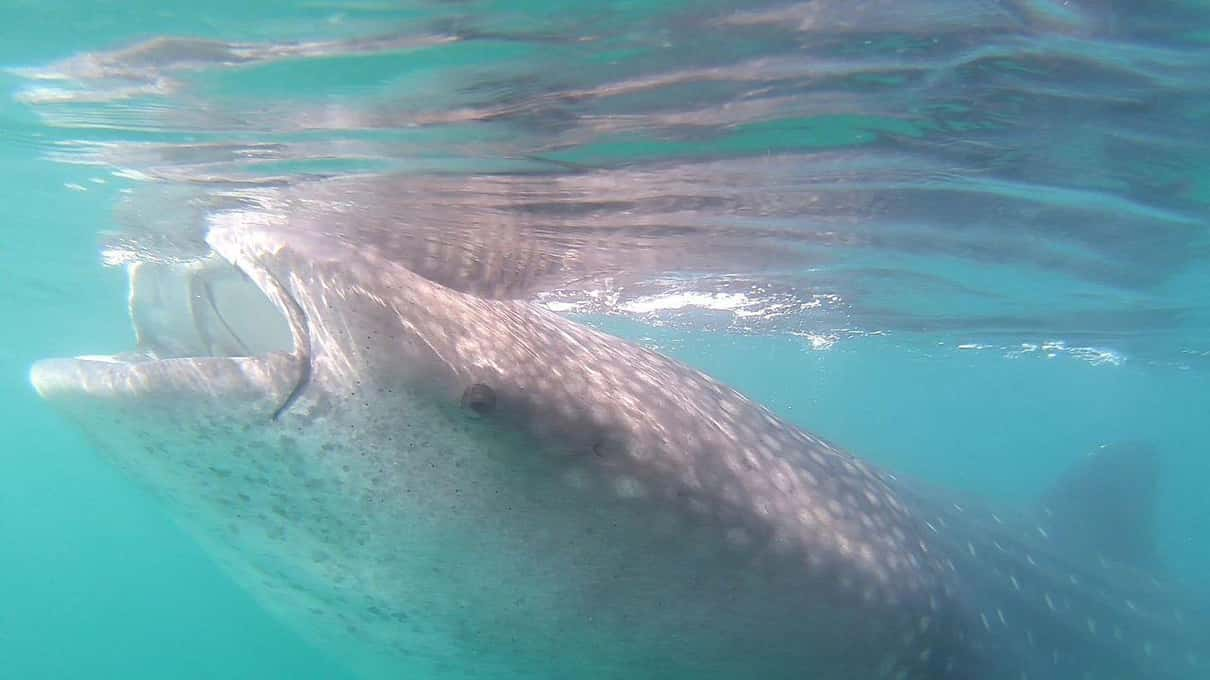
For all that size it lives on tiny prey. It is a filter feeder that swims slowly with its wide mouth open, straining plankton and small fish out of the water as it goes.
That diet is why the animal poses no threat to swimmers. It shows no interest in people and simply carries on feeding while you swim alongside. The real risks run the other way, from boats and careless hands.
Why the water near El Mogote draws them in
In winter the shallow water near the sandbar fills with plankton. The listings for the La Paz swims all point to this food as the reason the sharks gather here instead of passing by in deeper water.
Plankton is also why the bay often looks green or murky rather than clear blue. Divers might grumble about the visibility, but for a whale shark the cloudy water means dinner. A green day is often a good day to find them.
The sharks feed close to the surface, sometimes with the top of the head and the dorsal fin breaking the water. That habit lets you see them well with only a mask and snorkel, and no dive training at all, which our page on swimming with weaker swimmers and children explains in more detail.
Young sharks, winter months
The whale sharks in the Bay of La Paz are mostly juveniles. Lengths of roughly 4–8 meters (13–26 feet) are often mentioned, which is big enough to fill your view underwater and still small next to a grown adult.
They turn up roughly from November to April. Eco Migrations' listing says from mid-October, while Mexico Travel Adventure's gives November to April, and the start and end shift a little from one winter to the next. Our month-by-month guide to the season goes through the trade-offs.
Where the young sharks go for the rest of the year is still studied by researchers. For a visitor the practical point is simple, since outside the season the operators stop running whale shark swims.
Remoras, the passengers on board
Look closely at a whale shark and you will often spot slim fish stuck to its belly or flank. These are remoras, which hold on with a sucker on top of the head and ride along for free.
They pick up scraps and get a lift through the water without spending much energy. Watching a remora shift position on the spotted skin is one of the small details people remember after the big moment has passed.
A protected area with rules on the water
The feeding area near El Mogote is protected and regulated. Boats work inside a marked zone, keep their speed down and take turns approaching a shark, so a single animal is not crowded by several pangas at once.
The limits exist because whale sharks swim slowly at the surface and can be hit by propellers. Only a few swimmers enter the water at a time with a guide, and the crew will brief you before anyone gets wet.
Our rules for swimming with the sharks cover distance, touching and sunscreen one by one. None of them gets in the way of a good encounter, and following them keeps the sharks coming back.
Swim with someone who studies the bay
Eco Migrations runs its trip with a bilingual marine biologist who explains the sharks and the bay as you go. It starts at their office in the center of La Paz, where you get a full wetsuit and a snorkel kit, in a small group of eight per boat on the listing.
Wild animals, never a sure thing
Gathering near El Mogote is a pattern and not a timetable. The sharks are wild, so on some mornings they are spread out and hard to find, and the wind can keep the boats in port.
Nobody can promise a sighting, whatever an advert suggests. Our page on what happens when the sharks stay away explains the usual cancellation rules and how to plan a spare morning into your stay.
Choosing a boat to the sandbar
All the La Paz trips head for the same water, so the differences lie in the guide, the kit and the price. Eco Migrations' biologist-led swim, from ~$187, scores 4.9 from 40+ reviews on GetYourGuide and lasts about 4 hours.
Mexico Travel Adventure's shorter swim, from ~$123, meets at the Muelle Fiscal on the Malecón and also has a marine biologist guide. It sends swimmers into the water in groups of five so everyone gets a turn.
If you stay in Los Cabos, Cabo Adventures drives you up for the day instead. Prices vary by date and partner, and our comparison of the three tours and their prices sets them side by side. After the swim, the same bay leads north to the sea lions covered in our page on adding Espíritu Santo.